
- Home
- About
- Services
- Audit and Assurance
- Taxation in Kenya
- Human Resource Management
- Business Process Outsourcing(BPO)
- Consultancy and Advisory
- Management Advisory
- Assets and Investments Advisory
- Business Transformation and Turnaround
- Business Start-ups Incubation
- Family Business Advisory
- Financial Advisory
- Business and Corporate Strategy
- Property Advisory
- Business Valuation
- Business Plan Formulation
- Funding Proposals
- Mergers, Acquisition (M & A) and Restructuring
- Transaction Advisory Services
- Crisis Management
- Monitoring and Evaluation (M&E)
- Communication Services
- Industries
- Transportation
- Agriculture and Agribusiness
- Processing and Manufacturing
- Hospitality, Leisure and Tourism
- Construction and Real Estate
- NGOs and Charitable Trusts
- Distribution and General Trading
- Consultancy
- Financial Services
- Automotive Machinery & Equipment
- Water and Sanitation
- Healthcare
- Technology
- Energy, OIl, and Gases
- Betting and Gaming
- Education
- Resources
- Careers
- Relations
- Contact us
- Login
- Article
- October 27, 2021
- No Comments
- administrator
Key Ethical Approaches in HRM and Psychological Contract
What is human resource management (HRM)? It is the practice of recruiting, hiring, deploying and managing an organization’s employees. HRM involves conducting job analysis, planning personnel needs, recruiting the right people for the job, orienting and training, managing wages and salaries, providing benefits and incentives, evaluating performance, resolving disputes, and communicating with all employees at all levels. What is a psychological contract? This refers to the relationship between an employee and his or her employer. It involves mutual outcomes and inputs of each party. Key areas of interest For us to be able to understand the psychological contract of a company, we have to look at it from all points of view. This includes both the employer and the employee. In order to maintain a proper psychological contract in work place, it is important to be ethical in all that we do. A set code of ethics is very important to ensure that no one feels like their rights are being infringed on or even being ignored. Ethical issues A problem or situation that requires a person or organization to choose between alternatives that must be evaluated as right (ethical) or wrong (unethical). A proper code of ethics This is important because it helps change the context under which people view employment. The dynamics have changed greatly, and the social values around us are influencing the quality of work done. This is because the environment that one works in affects the attitude towards work. In a friendly environment the output is better than in a hostile environment. Recently, when operating a business one must abide to certain set code of ethics. This is under the notion of social responsibility by the corporate world. Employers should recognize that everyone working for them has a say and rights that should be put into consideration at all times. If the management is friendly to its subordinates, it makes working more of a team effort than a personal one. The company tends to gain more by using this approach. Personal beliefs The next factor that comes into play is the personal beliefs that every single person has. Despite the fact that there is a set code of ethics, what one believes in his/her heart to be right or wrong also plays a great role in either making or breaking the psychological contract at work. For instant, unjust and corrupt leaders are a good example of people with no sense of wrong and right. If employees abides by a set of principles instilled in them, then this makes workflow easier. However, a certain type of test should be conducted before hiring. The purpose of this test would be to find out what kind of principles the person lives by. Principled people will normally be more aware of the rights of everyone around them and hence reducing the chances of having disgruntled customers. Breach of contracts Some situations may arise that may lead to the breach of contract between the management and the employees. Such cases have led to conflict within the offices and this leads to low work output. An example of such a case is the issue regarding privacy. Sometimes it is hard to protect the interests of the company and at the same time those of the employees. The companies have to monitor all activities of the employees like the emails sent out of company computers. However, it can be seen as a breach of privacy when they go through these emails . Having a code of ethics in human resource management department will be very important at this time. This is because the employees will be able to trust that despite the fact that emails will be sorted through, they are not going to be exposed to the public hence protecting said privacy. Health issue Another issue regarding privacy is the health issue. Some argue that you have to know the HIV status of all the people you employ. However, the employees reserve the right to keep their health status private. However, it is important to recognize that they have to look after the interests of all other employees and not just the one. Some human resource management departments were faced with the dilemma on whether to treat them differently or not. However, people have been made aware of the fact that it cannot be transmitted through contact and hence the rest are all safe. Ethically, you cannot demand that people submit such results. However, the individuals who have such diseases should be careful in their relations with other workers. Due to this reason, most companies prohibit relationships between people working together. Such standards ensure that there is no transmission of such viruses or other STI. Protection of whistleblowers The other issue that has come up in regards to privacy is the protection of whistleblowers. Human resource departments have a hard time determining who is in the right and who isn’t. Whistleblowers are employees who report their bosses when they portray certain unethical behavior. This is a very tough situation because the employees are meant to be loyal to their bosses, there are situations where the good of many outweighs the good of one person. However, if these bosses were to abide by the code of ethics set by the company then there would be no issue to resolve in the first place. By going out of the right path, they put the employees and themselves in a compromising situation that disregards the psychological contract. This is because the bosses also have a responsibility to ensure that the workers are comfortable working at their company. Having a situation where an employee has to turn against the company is not an ideal situation. Discrimination Discrimination among the employees is another factor that human resource management departments have to deal with. Seeing as this is a fairly common practice the government had to come up with a framework to prevent discrimination against sex, race religion or even sexual orientation. Such practices…

- Article
- October 27, 2021
- No Comments
- administrator
The Power of Effective Communication in a Company
What is communication? Communication refers to the exchange of information either in writing or speaking and this is effective in how any business is able to relate with the customers, employees internally and to the general outsiders of the business externally. Effective communication therefore is a situation where the business is able to clearly and professionally send and receive information in a manner that identifies the business as unique among its competitors. Any business can’t make good sales if there is poor communication. Is effective communication powerful in a business? The answer is YES and having a powerful way to communicate internally and externally in a company will greatly trigger the success of a company. Communication is effective in enhancing the relationship between the customers and the business. It helps to reach out to more consumers as well as giving the customers an opportunity to freely express their opinions, complaints, suggestions and interact with the company with ease. Communication is able to effectively connect the company to more opportunities which can be invested to give additional profits and income to the business. It also reduces time wastage that would have been incurred if the business was to physically engage all its customers, suppliers and employees. Consequently, the only way to build solid wealth in a company is enhancing effective communication across everyone as time management is one of the most critical resources to being successful. How rich you become solely depends on how effectively you manage your time and how effectively a company manages its time entirely depends on effective communication. How to build effective communication in a company? How a company chooses to build its communication largely depends on its financial capacity and the actual size of the company. A smaller company (small and medium enterprises – SMEs) would prefer to use telephone, emailing, and courier services while a large company would use these and even other more expensive ways of communication such as websites, advertising software to communicate with its customers, outsiders, and employees. How much you effectively communicate your business idea will always have a great impact on how much profit a company will achieve at the end of every financial year. Therefore, this implies that any business intending to succeed must therefore plan to expand and gradually build its communication from the simple basics to effective communication. Channels for effective communication in a company? The formal communication channel transmits organizational information, such as goals or policies and procedures, and this further underlines the impact of effective communication in an organization. The channels can be used in marketing a company to increase sales. The main channels of effective communication are: (i) Face to face communication This is a social facial interaction where there is mutual influence of a person’s direct physical presence with his/her body language. It is highly persuasive since there is physical contact between the company representatives (sales team) and the other parties. Also called interpersonal communication. It creates a bond of trust between people due to live feedback translated through the body language and facial expressions, making it a great way to communicate directly to the customers who value trust before doing business. (ii) Mobile/telephone Communication This is the most preferred communication due to its reliability, convenience and is relatively fast in communication. Digital technology has made this channel even more effective in that it has been used on broadcast media marketing, through social networks like face-book, twitter, linked-in and emails. This is a wireless communication that allows transmission of voice and multimedia data via a computer or a mobile device without having connected to any physical or fixed link. Mobile application software such as whatsApp have significantly contributed to this channel of communication making it effective in a great way to a company. (iii) Electronic communication It is a computer-mediated communication in which individuals exchange messages with others, either individually or in groups. The internet is a hub of information and has greatly contributed to its success in most companies, and as a result there has been exchange of ideas and information which have eventually been invested in a business at a profit. (iv) Written communication This is a type of interaction that makes use of written words. It has a great significance in today’s business world, in that it is essential for preparing worthy promotional materials for business development. (v) Broadcast media communication it is mass communication that involves video and audio content usually used by companies for advertisements, where the content is distributed to a dispersed audience with the ability to craft creative and compelling messages to influence people. It combines television and on-air radio performance with opportunities for on-screen acting, motivational speaking and talk show hosting. What are the levels of effective communication in a company? a. Horizontal communication is the transmission of information between people, divisions, departments or units within the same level of organizational hierarchy. It is essential for smooth functioning of organizational activities and for interdepartmental coordination through: Reducing possible misunderstanding and conflict through meeting, discussion and face to face conversations. Improves group efforts and teamwork by reducing conflicts, controversies, and differences in opinions to establish consensus among the managers and workers. Performing smooth inter-departmental communication for larger companies. Gaining benefits of informal communication since the senders and the receivers hold the same position, status and honor. Little or no distortion of message to be communicated because senders and receivers communicate directly with each other. Create dynamism in the workplace to overcome misunderstandings among the managers, leading to an environment of cooperation, teamwork and team spirit. b. Vertical communication which is the transmission of information between different levels of the organizational hierarchy. Strengthens communication where the superior entrusts work to his/her subordinates and watches over them, while acting as a guide and mentor. It is feedback oriented where the top and bottom levels of management discuss and interact with each…

- Article
- October 27, 2021
- No Comments
- administrator
The types and purpose of COMPANY MEETINGS
Types and Purpose of Company Meetings Meaning of company meetings This is when two or more persons (shareholders or the directors or the debenture holder or of the contributories), get together at one place, at a specific time, for lawful purposes, to discuss any common issue. Types of meetings a. Public meetings These are the meetings that consider matters of public concern and to which all members of the public have access, subject to physical limitations of the place where the meeting is held or conditions imposed by any law. b. Private meetings These are meetings attended by people who have a specific right to attend. For example, Committees members of a welfare group or of a registered company. Therefore, company meetings fall under this category. The eight main types of company meetings Statutory Meeting Annual General Meeting Extra ordinary General Meeting Class Meeting Meeting of Debenture Holders Meeting of the Board of Directors Meeting of Creditors Meeting of Creditors and Contributories. The following is an explanation on the above listed types of meetings; 1. Statutory meeting Every public company limited by shares and every company limited by guarantee and having a share capital, must within a period of not less than one month and not more than 3 months from the date at which the company is entitled to commence business, hold a general meeting of the members which is to be called the Statutory Meeting. This meeting is held once in the lifetime of a company. In this meeting, the members are to discuss a report by the directors, known as the statutory report, which contains particulars relating to the formation of the company. Private companies are exempted from holding this meeting. 2. Annual General Meeting (AGM) General meeting of a company means a meeting of its members for specified purposes. Public companies must hold an annual general meeting within or by the end of the six months of its financial year. Private companies are not required to hold an annual general meeting, unless they are a traded company (a corporation whose shareholders have a claim to part of the company’s assets and profits) or their articles require it. Every company must in each year hold, in addition to any other meeting, AGM. The notice conveying the meeting must specify that it is a notice of the AGM. Every AGM must be held during business hours and on working days. The registrar may, for any special reason, extend the time for holding any AGM by any given period; but no extension of time is granted for holding the first AGM. There should be at least one AGM per year and as many meetings as there are years. Ordinary Business of an AGM The normal business transacted at an AGM depends upon the articles. The article provides that the ordinary business of such a meeting shall be: – (i) The declaration of dividends. (ii) The consideration of accounts. (iii) The election of directors in place of the retiring. (iv) Appointment of and fixing of the remuneration of auditors. Any business which is not defined as “ordinary business” of an AGM is known as special business. 3. Extra ordinary general meeting Any general meeting of the company which is not an AGM or a statutory meeting is called extra ordinary general meeting. Extra ordinary meetings can be convened either by the directors whenever they think fit or on the requisition of members of the company. Where directors think fit to convene a meeting, they do so by resolution passed at a duly convened and constituted meeting of the Board. Note that everything transacted at an extra ordinary meeting shall be deemed as special. The extra ordinary general meeting may be convened: – (a) By Board of Directors on its own or on the requisition of the members (b) By the requisitionists themselves on the failure of Board of Directors to call the meeting Extra ordinary meeting convened by Board of Directors: a) On its own: The Board of Directors may call an extra ordinary meeting whenever some special business is to be transacted which in the opinion of the Board of Directors, cannot be postponed till the next AGM. b) On requisition of members: – The requisite number of members of a company may ask for an extra ordinary general meeting to be held. The Board of Directors shall proceed to call such a meeting. The requisition for such a meeting by the members shall be signed: (i) In case of a company with share capital holders of not less than 10% of the paid-up capital of the company having a right of voting in regard to the matter of acquisition. (ii) In case of a company with no share capital, by members representing not less than one tenth of the total voting power in regard to the matter of requisition. A requisition signed by one of the joint owners of the shares has the same force and effects as if it has been signed by all of them. The requisition shall set out all matters for consideration on which the meeting is called and shall be deposited in the registered office of the company. The directors are required to convene such a meeting within 21 days from the date of deposit of the requisition, but if they fail to do so, the requisitionists themselves may convene the meetings, as nearly as possible in the manner required by the company’s articles for convening the meeting. The company must compensate the requisitionists for any reasonable expenses incurred and may repay out of sums payable by the company to such directors as were in default. Note: Unless the meeting is called to pass a special resolution, the requisite notice for an extra ordinary general meeting is 14 days (Saturdays, Sundays, Public holidays are not included). In case of unlimited company, 7 days’ notice is required, but where special resolution is required, 21 days. 4. Class meeting These meetings are held by…
- Article
- October 26, 2021
- No Comments
- administrator
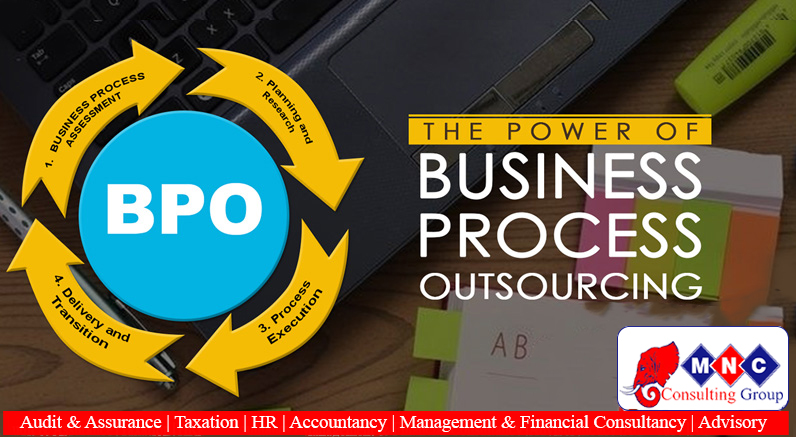
The Power of BUSINESS PROCESS OUTSOURCING (BPO)
What is Business Process Outsourcing (BPO)? Outsourcing (also referred to as contracting out) is a business practice used by companies to reduce costs or improve efficiency by shifting tasks, operations or processes to an external contracted third party for a significant period of time. Therefore, the task to be contracted out can be performed by the third party either onsite or offsite of the business. Why and when do we need Outsourcing? Outsourcing of one’s business functions and activities helps one to concentrate well on one’s core functions and helps controlling costs while working. Consequently, if the following questions come to your mind, then you should consider outsourcing your work: Are we working at a best possible favorable cost? Are the available resources utilized to the fullest efficiency? Whether the current available resources are able to support new technology and fight the market competition? Is there any other efficient way to handle these processes more professionally and quickly? Does the organizational team have the professional expertise to deliver efficient work? How can we cut down the recruitment and training costs? How outsourcing works : Outsourcing involves subcontracting parts of a company’s value-chain, (i.e. steps in the design, supply, production, marketing, sales and services processes) to other companies or contractors that specialize in those activities. Through outsourcing agreements, the client company hires separate companies to perform specific tasks in the value-chain on its behalf. Often, the work is performed under the name of the client. The kinds of outsourcing work performed vary widely across industry sectors. Some of the common outsourcing activities include: human resource management, facilities management, supply chain management, accounting, customer support and service, marketing, computer aided design, research, design, content writing, engineering, diagnostic services, and legal documentation. Benefits of outsourcing Cost advantage; the most visible benefit relates to the cost savings. You can get your job done at a lower cost and of higher quality as well. The cost saving by a big margin is enhanced by outsourcing plus high quality of service. However, ensuring low-cost does not mean low quality. Increased efficiency; this is doing the job better with knowledge and understanding of the domain. This leads to an increase in productivity and efficiency. Focus on core business; outsourcing enables a company to focus on building their own brand, invest in research and development and hence providing high value added services. Save on infrastructure and technology; outsourcing eliminates the need of investing in infrastructure. This is because the outsourcing partner takes the responsibility of the business processes and hence develops infrastructure for the same. Key drivers for outsourcing by companies Focus; companies may choose to outsource so as to continue focusing on their core business processes while delegating time consuming processes to external agencies. Value; lower operational and labour costs are among the primary reasons why a company outsources. When properly executed it has a defining impact on a company’s revenue recognition and can deliver significant savings. Outsourcing helps companies to tap in to and leverages a global knowledge base, having access to worldwide capabilities. Company can outsource to gain access to resources not available internally. Outsourcing saves cost and provide better capital funds to companies thus increasing the company’s profit. By delegating responsibilities to external agencies, companies can be able concentrate on core functions there by increasing revenue. Risk-sharing; outsourcing helps companies mitigate/share risks. Outsourcing enables companies to realize the benefits of business re-engineering. Some companies also outsource to help them expand and gain access to new markets. This is by taking closer of the service offered to their end users. For instance, many manufacturers outsource the services of distribution by appointing distributors within a certain region. Challenges of outsourcing Fall in service quality; the service delivered across the globe may not meet the quality expectations. When outsourcing, companies should examine the performance of the vendor and the technical competence. Security concerns; the core concern in outsourcing ethics is confidential information security. Companies should know about the security systems in place and also the safety of electronic data storage. If your outsourcing partner does not have adequate information about security measures, it might be a good idea to be clear on them. Environmental issues; the vendor companies may practice environmentally damaging processes. They may need to conduct periodic audits to ensure compliance. Access to skilled resources; gets access to expertise and capabilities from your outsourcing partner. Faster and better services; outsourcing makes service offering better with high quality deliverables and decrease the lead time it takes for the company’s product to reach the market. Risks related to outsourcing Risk of exposing confidential data; when an organization outsources, it involves the risk of exposing confidential company’s information to a third party. Hidden costs; although outsourcing most of the times are cost- effective, at times the hidden costs involved in signing a contract across international boundaries may pose a serious threat. Lack of customer focus; an outsourced vendor may be catering to the expertise-needs of multiple organizations. At a time in such situations, vendors may leave complete focus on your organization task. Various types of Business Process outsourcing a. Professional Services Outsourcing It’s very common for many companies to outsource their complicated tasks and processes. It is the most popular type of outsourcing as it saves a massive amount of money on overhead. The most outsourced services are skill specific such as IT, legal and accounting. b. Manufacturing Outsourcing This is the most pushed towards type. However, the cost of making your own products locally is significantly high. Moreover, paying the factory workers and raw material cost is massive. But, if you outsource your manufacturing to china for example, you’ll get much lower cost per product. This has been a growing trend for a while now. So, companies are leaning towards reducing blue collar jobs. Many car company utilizes this process to cut down on their product assembly time and cost. Tedious processes such as installing windows in all their models. c. Process-Specific Outsourcing Other models include…
- Article
- October 25, 2021
- No Comments
- administrator
The key stages, processes and strategies in PRODUCT DEVELOPMENT
What is product development? This is the improvement of an existing product or the introduction of a new product in a market. Reasons for product development Company growth objectives; product development strategy is one of the keys enabling tools for the company to continually grow. For this reason, the company will be able to penetrate existing markets and new ones. Technological change; Companies may undertake this strategy not because it is a luxury but because it is a necessity for survival as technology emerges. Replace products at the maturity stage; when a company’s product reaches maturity stage, it can’t grow anymore hence has lower cash flow leading to the developing new ones to replace the products at the maturity stage. Response to both domestic and foreign competition; in this dynamic competitive business world, companies must develop strategies to respond to, outdo and overcome any form of competition that the business may pose. Changing customer’s requirements, needs, and tastes; Customers have a lot to choose from, are less brand loyal, and have changing needs, requirements, and taste for the product they need hence this strategy helps to overcome this. Criteria for successful new product development Have a uniquely superior product; the product should be highly differentiated, one of superior features, and of high quality. Well defined product concept; the company should carefully define and assess the target market, product requirement, and benefits. Technological and marketing synergy; Combination of both, technology and marketing strength brings a good breakthrough for the strategy. Quality of execution at all stages; should be quality-driven and high standards of high quality should be maintained at all stages. Avenues of New-Product Development A firm can obtain new products through: Acquisition; refers to the buying of a whole company, a patent, or a license to produce someone else’s product. New product development; involves the original products, product improvements, product modifications, and new brands developed from the firm’s own research and development. Reasons for new product failure Overestimation of market size Poor design Incorrect positioning Wrong timing Priced too high Ineffective promotion Management influence High development costs Competition New-Product Development Process 1. Idea generation New idea generation is the systematic search for new product ideas. To create a large number of ideas Sources of new-product ideas Internal sources this involves the company’s own formal research and development, management and staff, and intrapreneurial programs. External sources refer to sources outside the company such as customers, competitors, distributors, suppliers, and outside design firms. 2.Idea screening This refers to reviewing new-product ideas in order to drop poor ones as soon as possible. 3. Concept Development and Testing; This involves; Product ideas for a possible product that the company can see itself offering to the market. Product concept is a detailed version of the idea stated in meaningful consumer terms. Product image is the way consumers perceive an actual or potential product. Concept testing refers to testing new-product concepts with groups of target consumers. To find out how attractive each concept is to customers, and choose the best one. 4. Marketing strategy development This refers to the initial marketing strategy for introducing the product to the market. Marketing strategy statement Part 1: Description of the target market The planning product positioning; sales, market share, and profit goals Part 2: Price distribution and budget Part 3: Long-term sales, profit goals, and marketing mix strategy 5. Business analysis This involves a review of the sales, costs, and profit projections to find out whether they satisfy the company’s objectives. 6. Product Development This involves the creation and testing of one or more physical versions by the research and development (R&D) or engineering departments. Requires an increase in investment 7. Test marketing This is the stage at which the product and marketing program are introduced into more realistic marketing settings. Test marketing provides the marketer with experience in testing the product and entire marketing program before full introduction. A firms conduct test market when it has uncertainty about product or marketing program When firms may not test market: Simple line extension; Copy of competitor product; Low costs; Management confidence Approaches to test marketing a. Standard test markets Small representative markets where the firm conducts a full marketing campaign Uses store audits, consumer and distributor surveys, and other measures to gauge product performance The results of standard test markets are used to; Forecast national sales and profits Discover product problems Fine-tune the marketing program Challenges of standard test markets Cost Time Competitors can monitor the test as well Competitor interference Competitors gain access to the new product before introduction b. Controlled test markets Panels of stores that have agreed to carry new products for a fee Less expensive than standard test markets Faster than standard test markets Competitors gain access to the new product c. Simulated test markets Events where the firm will create a shopping environment and note how many consumers buy the new product and competing products Provides measure of trial and the effectiveness of promotion Researchers can interview consumers 8. Commercialization This is the introduction of the new product into the market. It involves; When to launch Where to launch Planned market rollout (the widespread public introduction of a new product ) Importance of new product development strategy to a firm Helps an organization to penetrate in its current market and enter new ones. It helps an organization to meet the changing customer’s needs as its continuous product development is guaranteed and facilitated. Assists an organization to achieve its growth objectives; through increased assortment, increased productive capacity of its facility. Performs as a strategy to curb competition. Acts as the basis for an organization to diversify across markets and increased product portfolio. New-Product Development Strategies a. Customer-centered new product development This focuses on finding new ways to solve customer problems and create more customer satisfying experiences Begins and ends with solving customer problems The most successful…

- Article
- May 5, 2021
- 36 Comments
- administrator
Raising business finances through CROWDFUNDING
[vc_row][vc_column][vc_custom_heading source=”post_title” use_theme_fonts=”yes”][vc_column_text]What is crowdfunding? Crowdfunding is a method of raising capital through the joint effort of friends, family, customers, and individual investors. This approach taps into the collective efforts of a large pool of individuals “primarily online via social media and crowdfunding platforms” and leverages their networks for greater reach and exposure. Overview of crowdfunding Crowdfunding is essentially the opposite of the conventional approach to business finance. Traditionally, if you wished to raise capital to start a business or launch a new product, you would need to pack up your business plan, market research, and prototypes, and then shop your idea around to a limited pool or wealthy individuals or institutions. These funding sources included: Banks Angel investors Venture capital firms This really limited your options to a few key players. Think of this fundraising approach as a funnel, with you and your pitch at the wide end and your audience of investors at the closed end. Fail to point that funnel at the right investor or firm at the right time, and that’s your time and money lost. Crowdfunding platforms, on the other hand, turns that funnel on-end. By giving you, the entrepreneur, a single platform to build, showcase, and share your pitch resources, this approach dramatically streamlines the traditional model. Traditionally, you’d spend months sifting through your personal network, vetting potential investors, and spending your own time and money to get in front of them. With crowdfunding, it’s much easier for you to get your opportunity in front of more interested parties and give them more ways to help grow your business, from investing thousands in exchange for equity to contributing funds in exchange for a first-run product or other reward. Crowdfunding verses traditional business financing Benefits of Crowdfunding By tapping into a wider investor pool to enjoying more flexible fundraising options, there are a number of benefits to crowdfunding over traditional methods. Here are just a few of the many possible advantages. Presentation – By creating a crowdfunding campaign, you go through the invaluable process of looking at your business from the top level its history, traction, offerings, addressable market, value proposition, and more and boiling it down into a polished, easily digestible package. Reach – By using a crowdfunding platform, you have access to thousands of accredited investors who can see, interact with, and share your fundraising campaign. PR & Marketing – From launch to close, you can share and promote your campaign through social media, email newsletters, and other online marketing tactics. As you and other media outlets cover the progress of your fundraise, you can double down by steering traffic to your website and other company resources. Validation of Concept – Presenting your concept or business to the masses affords an excellent opportunity to validate and refine your offering. As potential investors begin to express interest and ask questions, you’ll quickly see if there’s something missing that would make them more likely to buy in. Efficiency– One of the best things about online crowdfunding is its ability to centralize and streamline your fundraising efforts. By building a single, complete profile to which you can funnel all your prospects and potential investors, you eliminate the need to pursue each of them individually Types of Crowdfunding Just like there are many different kinds of capital round raises for businesses in all stages of growth, there are a variety of crowdfunding types. The crowdfunding method depends on the type of product or service you offer and your goals for growth. The 3 primary types are: Donation-based Reward based Equity crowdfunding Donation-Based Crowdfunding Broadly speaking, you can think of any crowdfunding campaign in which there is no financial return to the investors or contributors as donation-based crowdfunding. Common donation-based crowdfunding initiatives include: Fundraising for disaster relief Charities Non-profits Medical bills Rewards-Based Crowdfunding Rewards-based crowdfunding involves individuals contributing to your business in exchange for a “reward,” typically a form of the product or service your company offers. Even though this method offers sponsors a reward, it’s still generally considered a subset of donation-based crowdfunding since there is no financial or equity return. Equity-Based Crowdfunding Unlike the donation-based and rewards-based methods, equity-based crowdfunding allows contributors to become part-owners of your company by trading capital for equity shares. As equity owners, your contributors receive a financial return on their investment and ultimately receive a share of the profits in the form of a dividend or distribution. About the Author Thank you for reading this article. The author, James Ndambiri is an avid Business Advisor and Consultant: A Tax Surgeon, Proficient Accountant, Skilled Auditor, a Guru in Financial and Investment management, Expert in Business Strategy Formulation, Business Transformation Wizard, Family Business Advisor, Lecturer, Business Coach and a Family Man. James is the Founder, Team Leader, CEO & Managing Partner of MNC Consulting Group. MNC Consulting Group is your most trusted and respected professional business consulting firm recognized by our clients for delivering excellent business advisory and consulting services that create value to their ventures. With our focus set on value addition, we offer our clients the highest quality professional services in Accounting, Audit and assurance, Tax, Business Transformation, Investments and Financial Advisory, Family Business Advisory, Company Secretarial Services and Property Management that address their business needs through attracting, recruiting and retaining knowledgeable and passionate professionals who enable us to deliver superior results while contributing positively to the community in which we live and work. Make us your business partner by always consulting with us. ‘‘With us, you are in safe hands”[/vc_column_text][/vc_column][/vc_row]

- Article
- April 28, 2021
- 24 Comments
- administrator
Capital Gain Tax in Kenya
[vc_row][vc_column][vc_custom_heading source=”post_title” use_theme_fonts=”yes”][vc_column_text]What is Capital Gains Tax? Capital Gains Tax is a tax chargeable on the whole of a gain which accrues to a company or an individual on or after 1st January, 2015 on the transfer of property situated in Kenya, whether or not the property was acquired before 1st January, 2015. This tax had been suspended in 1985 but was re-introduced effective 1st January, 2015. What is the rate of tax? The rate of tax is 5% of the net gain. It is a final tax and cannot be offset against other income taxes. What is property? Property is defined in the law (Eighth Schedule to the Income Tax Act). It includes land, buildings and marketable securities. Who is liable to pay the tax? The tax is to be paid by the person (resident or non-resident) transferring the property, that is, the transferor. The transferor can either be an individual or a corporate body. What constitutes a transfer? A transfer takes place: – a) where a property is sold, exchanged, conveyed or disposed of in any manner (including by way of gift); or b) on the occasion of loss, destruction or extinction of property whether or not compensation is received; or c) on the abandonment, surrender, cancellation or forfeiture of, or the expiration of rights to property. How do you determine the net gain? The net gain is the excess of the transfer value over the adjusted cost of the property that has been transferred. It is this excess that is subjected to tax at 5%. The Transfer value of the property is the amount or value of consideration or compensation for transfer of the property less incidental costs on such transfer. The Adjusted cost is the sum of the cost of acquisition or construction of the property; expenditure for enhancement of value and/or preservation of the property; cost of defending title or right over property, if any; and the incidental costs of acquiring the property. The adjusted cost shall be reduced by any amounts that have been previously allowed as deductions under Section 15(2) of the Income Tax Act. How will related party transactions be treated? Two parties are related if: a) Either person participates directly or indirectly in the management control or capital of business of the other; or b) A third person participates directly or indirectly in the management control or capital of business of both. Where there is concern that a related party transaction may have led to reduction in the transfer value with a view to minimizing the capital gains tax, the Commissioner will make necessary adjustments and/or revaluation to determine the market price What is the due date/tax point? It is a transaction-based tax and should therefore be paid upon transfer of property but not later than the 20th day of the month following that in which the transfer was made. How is the tax to be declared? The taxpayer will do a self-assessment to determine the gain upon which tax is computed. The computations are subject to Commissioner’s confirmation of correct gain as the basis of tax computation. Upon transfer of property the transferor shall complete the relevant form (CGT 1) as appropriate and compute and pay the tax thereon. What happens when a loss is made? The loss may be carried forward to be offset/deducted against a gain of a similar nature (that is, a capital gain) at a future date. What documents/information will be required? a) Completed CGT form by the seller b) Copy of Sale/Transfer Agreement of the property c) Proof of the incidental costs related to the acquisition and transfer of the property d) A copy of the title deed or ownership document for the property e) Report from a registered valuer for property transactions between related parties f) Any other document/information that the Commissioner may require Are there any exemptions from capital gains tax? Certain transactions are exempted as follows: a) income that is taxed elsewhere as in the case of property dealers b) issuance by a company of its own shares and debentures c) transfer of machinery including motor vehicles d) disposal of property for purpose of administering the estate of a deceased person e) vesting of property in the hands of a liquidator or receiver f) transfer of individual residence occupied by the transferor for at least three years before the transfer g) compensation by Government for property acquired for infrastructure development h) transfer of asset between spouses as part of divorce settlement i) sale of land by an individual where the proceeds is less than Kshs. 30,000 j) sale of agricultural land by individuals outside gazetted townships where the property is less than 100 acres k) Exchange of property necessitated by : incorporation, recapitalization, acquisition, amalgamation, separation, dissolution or similar restructuring involving one or more companies which is certified by the Cabinet Secretary to have been done in the public interest l) transfer of investment shares by a body exempted under Paragraph 10 of the First Schedule m) transfer of investment shares by retirement benefits scheme registered with Commissioner Treatment of Extractive Industry The net gain on disposal of interest in a person owning immovable property in the mining and petroleum industry is taxable. The applicable rate of tax is as per the Ninth Schedule to the Income Tax Act – 30% for residents and 37.5% for non residents with permanent establishments. The taxable gain is the net gain derived on the disposal of an interest in a person, if the interest derives its value from immovable property in Kenya. Immovable property means a mining right, an interest in a petroleum agreement, mining information or petroleum information. About the Author Thank you for reading this article. The author, James Ndambiri is an avid Business Advisor and Consultant: A Tax Surgeon, Proficient Accountant, Skilled Auditor, a Guru in Financial and Investment management, Expert in Business Strategy Formulation, Business Transformation Wizard, Family Business Advisor, Lecturer, Business Coach and a Family Man. James is the…
- Article
- April 21, 2021
- 24 Comments
- administrator
Developing a Business Advisory Board (BAB)
[vc_row][vc_column][vc_custom_heading source=”post_title” use_theme_fonts=”yes”][vc_column_text]What is a Business Advisory Board (BAB)? A Business Advisory Board is a group of local business and community leaders who are recruited by the owners of the business to serve as mentors. Key role of a Business Advisory Board (BAB) Providing guidance and mentorship Introducing the entrepreneur to other business leaders in the community Suggesting project ideas Providing access to needed resources Funding opportunities Giving feedback on projects and presentation Difference between Business Advisory Board (BAB) and Board of Directors (BoD) Size of the BAB An effective BAB should consist of around 5 to 8 members. Greater numbers are acceptable, but a minimum of 6 would be needed to ensure a range of organizations are represented; a range of specific and general management skills are represented; and gender diversity is represented. Factors to consider when determining the size of a BAB Manageability Budget Sustainability Quorum Diversity Responsibility Skills requirement Sector representation of members of the BABs Members of leading businesses, educational and civic organization Members of the organization sponsoring the business/company Members of the Mass Media Institutional administrators Religious organizations Members of various professional bodies Representative from political arena Local managers from national and/or State businesses Managers from local industry associations Skills requirements for BABs BAB members will be most effective if they can bring some or all of the following skills to the team. General management Specific technical skills e.g. marketing, finance, IT, HR etc Project management Mentoring Any specific skills required by projects eg scientific, theatrical, media etc Frequency of meeting of BABs Meetings should be held on a quarterly basis at minimum – anything less and there may not be enough contact between members to ensure the BABs effectiveness. New BABs may wish to hold more frequent meetings at first. BAB members can be invited to participate in other events such as networking socials, presentation practices, and various project-related events. Subcommittees should meet more frequently. Required level of commitment expected from BAB members BAB members are requested to: Make themselves available for meetings wherever possible. Be willing to provide constructive mentoring, coaching and guidance to teams and individual team members where applicable. Provide feedback to their organization on their activities as a BAB member. Be willing to provide in-kind and/or financial support where possible. Suggest possible projects. Tips to maintain a satisfactory level of commitment from BAB members: Be clear about expectations right from the onset through the BAB Member Handbook and initial discussions. Hold a begging of the year meeting to review your plans for the new year and introduce new members of the board. Schedule meetings and events as early as possible to increase attendance. It also helps if meetings are scheduled on a certain day, such as the first Thursday of the month. Record action items in the minutes of each meeting and be sure to follow up with those responsible for their completion. Establish a term (between one and three years) for BAB members to serve so they know they have a finite period to provide support and commitment to the team. Ensure open communication with BAB members so that they still feel “in the loop” even if they miss a meeting or an event. Share links to your team website and social media pages. Encourage committee members to take the lead, but make sure their goals are realistic and compatible with your program’s mission. Establish and maintain a structure that works for everyone. Seek out new members and provide a thorough orientation for those who join. Provide regular updates about your program and let members know how their work has helped you progress toward your goals. Ask for opinions or involvement only when it fits with the group’s mission and role as advisors. Thank members regularly in many different ways in person, in handwritten notes, via e-mail, in your newsletter for the work they are doing. Cost of running a BAB The amount of money required is relative and depend with the amount allocated in the budget for the following purpose: Printing (e.g. for invitation packages) Facility rental Refreshments and/or lunch (for meetings or other BAB events) Appreciation gifts (e.g. at Christmas) Sitting allowance (Not Compulsory) Steps for developing an effective BAB Obtain approval from your board of directors or other governing body to establish. Establish the purpose and scope of the group (increase feasibility, offer informed input, keep engaged with the community). Recruit members that fit with the group’s purpose. Build your team and develop structure. Prepare members for their role and the work they will do for your program (orientation, review mission, clarify extent and limit of authority). Empower the group to develop a clear scope of work: Facilitate a conversation about which program areas would benefit from the group’s support, such as volunteer recruitment and training, fundraising, or community awareness. Discuss which of the identified areas need support right now and which could wait or need little support. Have the group establish measurable objectives and specific activities for the areas they identify and a lead person for each area of involvement the committee plans. Best practices for advisory board creation and success Homework: Give the Advisory Board members simple ways to get ready for the meeting: e.g., reading a succinct brief on a problem to be discussed or going into the market to get smart about the context of a category to be presented. Share the questions you plan to ask so advisors have time to think about issues and back up their responses with examples, if possible. Preparation: Executives who manage the Advisory Boards within a company are critical to its success. Preparing the agenda as well as the teams who participate and following up are critical if ideas are to turned into action. Presentations: Presentations should be well edited, free of jargon, concise and designed to stimulate thinking rather than get buy-in. Questions are more important than answers. Participation: When the intention is to spark new thinking that translates…

- Article
- April 14, 2021
- 251 Comments
- administrator
Accelerating Company Growth through Mergers and Acquisition (M&A)
[vc_row][vc_column][vc_custom_heading source=”post_title” use_theme_fonts=”yes”][vc_column_text]What is merger and acquisition? Mergers and acquisitions (M&A) is basically consolidation of companies. Differentiating the two terms, Mergers is the combination of two companies to form one, while Acquisitions is one company taken over by the other. The reasoning behind M&A generally given is that two separate companies together create more value compared to being on an individual stand. With the objective of wealth maximization, companies keep evaluating different opportunities through the route of merger or acquisition. Major reasons for mergers and acquisition (M&A) 1.Synergy The most used word in M&A is synergy, which is the idea that by combining business activities, performance will increase and costs will decrease. Essentially, a business will attempt to merge with another business that has complementary strengths and weaknesses. 2. Diversification / Sharpening Business Focus These two conflicting goals have been used to describe thousands of M&A transactions. A company that merges to diversify may acquire another company in a seemingly unrelated industry in order to reduce the impact of a particular industry’s performance on its profitability. Companies seeking to sharpen focus often merge with companies that have deeper market penetration in a key area of operations. 3.Growth Mergers can give the acquiring company an opportunity to grow market share without having to really earn it by doing the work themselves – instead, they buy a competitor’s business for a price. Usually, these are called horizontal mergers. For example, a beer company may choose to buy out a smaller competing brewery, enabling the smaller company to make more beer and sell more to its brand-loyal customers. 4.Increase Supply-Chain Pricing Power By buying out one of its suppliers or one of the distributors, a business can eliminate a level of costs. If a company buys out one of its suppliers, it is able to save on the margins that the supplier was previously adding to its costs; this is known as a vertical merger. If a company buys out a distributor, it may be able to ship its products at a lower cost. 5.Eliminate Competition Many M&A deals allow the acquirer to eliminate future competition and gain a larger market share in its product’s market. The downside of this is that a large premium is usually required to convince the target company’s shareholders to accept the offer. It is not uncommon for the acquiring company’s shareholders to sell their shares and push the price lower in response to the company paying too much for the target company. Mergers & Acquisitions can take place: by purchasing assets by purchasing common shares by exchange of shares for assets by exchanging shares for shares Principle behind any M&A is 2+2=5 There is always synergy value created by the joining or merger of two companies. The synergy value can be seen either through the Revenues (higher revenues), Expenses (lowering of expenses) or the cost of capital (lowering of overall cost of capital). A Successful Merger is a Planned Merger: Ideally, you would start planning as soon as you decide to buy something. If you have no plan for the target company, you are going to pay the wrong price and you are not going to be ready to handle the integration. I would do a couple of days planning right at the start. At latest, I would start building a full integration plan around 100 days before you believe the deal will take place. Careless Acquisitions Causes Reverse Multiple Arbitrage: If you buy a company that doesn’t fit into your strategy, you may suffer from reverse multiple arbitrage since investors will no longer be able to identify your true brand or mission. An M&A is an arranged marriage There is no love at the beginning The issues start Day One Executives announce the once hush-hushed M&A information Employees pretend to be excited as FEAR ripples through both companies The C suite (senior executives) announces: “This will be great for everyone” No one is buying that promise Types of mergers and acquisition There are five commonly-referred to types of business combinations known as mergers: conglomerate merger, horizontal merger, market extension merger, vertical merger and product extension merger. The term chosen to describe the merger depends on the economic function, purpose of the business transaction and relationship between the merging companies. 1.Conglomerate merger A conglomerate merger is a merger between firms that are involved in totally unrelated business activities. There are two types of conglomerate mergers: pure and mixed. Pure conglomerate mergers involve firms with nothing in common, while mixed conglomerate mergers involve firms that are looking for product extensions or market extensions. 2.Horizontal Merger A merger occurring between companies in the same industry. Horizontal merger is a business consolidation that occurs between firms who operate in the same space, often as competitors offering the same good or service. Horizontal mergers are common in industries with fewer firms, as competition tends to be higher and the synergies and potential gains in market share are much greater for merging firms in such an industry. 3.Product Extension Mergers A product extension merger takes place between two business organizations that deal in products that are related to each other and operate in the same market. The product extension merger allows the merging companies to group together their products and get access to a bigger set of consumers. This ensures that they earn higher profits. 4.Vertical Merger A merger between two companies producing different goods or services for one specific finished product. A vertical merger occurs when two or more firms, operating at different levels within an industry’s supply chain, merge operations. Most often the logic behind the merger is to increase synergies created by merging firms that would be more efficient operating as one. 5. Market Extension Mergers A market extension merger takes place between two companies that deal in the same products but in separate markets. The main purpose of the market extension merger is to make sure that the merging companies…
- Article
- April 7, 2021
- 8 Comments
- administrator
Creating a Winning Business Strategy
[vc_row][vc_column][vc_custom_heading source=”post_title” use_theme_fonts=”yes”][vc_column_text]Business strategy- What is it? What exactly is business strategy? In simple terms, a business strategy is an articulation of the overall direction of the business. Strategies that are identical to those of your competitors can result in the failure of your objectives. Business strategy can also be seen as a decision made at the highest levels of the company on positioning and direction. Such a decision serves to establish a clearly defined framework for subsequent decisions. Accordingly, strategy and decision-making become inseparable; without organizational competence for decision-making, the formulation of a strategy in itself does not have much meaning. Business strategy – Need and purpose The reason why having a strategy is so important is because it gives business time to get a sense of how they are preforming, what their capabilities are, and if these capabilities are able to help them grow. Developing a good business strategy is a thoughtful process. It takes a balanced approach to come up with a strong but flexible business strategy that can absorb change without disintegrating. Just as a good topographical map is indispensable to a hiker outlining explicit geographical hazards, so is a good business strategy to a company. It encompasses information on competitors and technology, suppliers and customers and provides directional guidance. Key principles about business strategy Business strategy compete to be unique, not to be the best Strategy is a pattern in a stream of decisions Business strategy compete for profit as it’s the aim of every business to make profit Know your industry before you develop your strategy Strategy is thinking about a choice and choosing to stick with your thinking The essence of strategy is choosing what not to do A good strategy requires you to keep moving because a good strategy is a sigh of success Key Components of a winning strategy plan Vision The CEO and senior management likely has a focused vision for the current and future of their organizations. It’s imperative that the executives include their shared vision into a successful business strategy. Mission Your mission statement should embody the values of the organization, to which you will always remain true. A good mission statement should include a clear, concise expression of the company’s purpose, philosophy and commitment. Objectives Along with your company’s short- and long-term goals, your objectives should state the specific objectives your business strategy will accomplish as well as a timeline outlining when management believes the company will reach them. In all cases, your company’s objectives should focus on achieving the broader goals as displayed in your mission statement. Strategies This is the how you will achieve your goals and objectives. While strategic planning groups often express different ideas of how to reach the outcomes your strategies target, brainstorming and free discussion typically results in agreement on a business strategy or strategies that should work. Even in smaller organizations, CEOs should try to involve as many people as possible. This is more important than just keeping everyone on the same page. You often learn that staff members have winning ideas that need to be considered. Perhaps more important, though, is that inclusion creates buy-in, and any winning strategy will need engaged employees to be successful. Action Plans Clearly, great vision and mission statements are useless if not acted upon. Action plans are the engines that make strategic plans succeed. Creating detailed action plans that include what is to be done, who is accountable for it, and when it is due, is an ingredient commonly glossed over in strategic planning. Too many organizations create outstanding strategies without attaching specific action plans, and so they gather dust until the next strategic planning meeting. Type of strategy 1.Generic or general strategy Strategy, in general, refers to how a given objective will be achieved. Consequently, strategy in general is concerned with the relationships between ends and means, that is, between the results we seek and the resources at our disposal. Strategy and tactics are both concerned with formulating and then carrying out courses of action intended to attain particular objectives. For the most part, strategy is concerned with deploying the resources at your disposal whereas tactics is concerned with employing them. Together, strategy and tactics bridge the gap between ends and means. 2. Corporate strategy The overall scope and direction of a corporation and the way in which its various business operations work together to achieve particular goals. Corporate strategy defines the markets and the businesses in which a company will operate. It is typically decided in the context of defining the company’s mission and vision, that is, saying what the company does, why it exists, and what it is intended to become. 3. Competitive strategy It’s defined as the long-term plan of a particular company in order to gain competitive advantage over its competitors in the industry. It is aimed at creating defensive position in an industry and generating a superior ROI (Return on Investment). Such type of strategies plays a very important role when industry is very competitive and consumers are provided with almost similar products. Before devising a competitive strategy, one needs to evaluate all strengths, weaknesses, opportunities, threats in the industry and then go ahead which would give one a competitive advantage. Types of competitive strategies a. Cost Leadership Here, the objective of the firm is to become the lowest cost producer in the industry and is achieved by producing in large scale which enables the firm to attain economies of scale. High capacity utilization, good bargaining power, high technology implementation are some of factors necessary to achieve cost leadership. b. Differentiation leadership Under this strategy, firm maintains unique features of its products in the market thus creating a differentiating factor. With this differentiation leadership, firms target to achieve market leadership. Superior brand and quality, major distribution channels, consistent promotional support etc. are the attributes of such products. c. Cost focus Under this strategy, firm concentrates on specific market segments and keeps its products…
[vc_row][vc_column][vc_wp_search][stm_post_type_list style=”style_2″ title=”Categories” num=”5″ size=”58×58″][/vc_column][/vc_row][vc_row][vc_column][stm_testimonials number_row=”1″ crop=”130″ bullets=”false” img_size=”52×52″ style=”style_4″ number=”3″][stm_button button_pos=”fullwidth” button_icon_pos=”left” button_icon=”fa fa-file-text-o” button_icon_class=”custom” button_icon_color=”#ffffff” button_icon_size=”20″ button_divider=”divider” link=”url:%2Fwp-content%2Fuploads%2F2017%2F05%2FENERGY-STAR.pdf|title:DOWNLOAD%20BROCHURE|target:%20_blank|” css=”.vc_custom_1528456158928{margin-bottom: 40px !important;border-bottom-width: 3px !important;padding-bottom: 35px !important;border-bottom-color: #213364 !important;border-bottom-style: solid !important;}”][stm_post_type_list post_type=”stm_projects” css=”.vc_custom_1494417930830{margin-bottom: 15px !important;border-bottom-width: 0px !important;padding-bottom: 0px !important;}”][/vc_column][/vc_row]
